
Abhi
Read
- Yahoo story $(p=9)$
- Naukri $''$ $(p=10)$ reverse
Yahoo Story
you may want to update yourself
on Yahoo's MyWeb 2.0 (based on Flickr technology).
In my notes (Co-creation of
Value) I have listed a few examples of how we can capture the knowledge/wisdom
of HR mgrs/Jobseekers - in order to stay, far far ahead of Competition.
Naukri story
It always helps to know how your
competitor's mind works.
So, whatever Bhikchandani is
"thinking" of, must always interest us!
Right now, he is thinking
- "to put out all his 80,000 job-adds on
aggregators such as Google and Yahoo (this will give his Clients, a larger
response level).
- "His search algorithm will be a lot more
robust than the single box searches of the US. (In the last year itself,
Naukri changed its Search algorithm 20 times to take into account charging
needs of the Client base).
- he admires Google Consumer Surplus model
With such thinking - and an
expected revenue of Rs. 90 crores + a staff of 775 - Naukri is our FORMIDARLE
Opponent!
But, longtime back, we concluded
that, we cannot take on Naukri/Monster/timesjobs, on their turf, following
their rules!1
So, we have gone about creating
for ourselves an altogether different "category" within online
recruitment marketplace, where we are the ONLY (Single) player - where
we have no competition.2
That is World-Wide-Jobs3
And we are trying to
publicize/brand WWJ thru JAS - without spending a rupee.4
Even if Monster/Naukri/timesjobs
notice WWJ, they are unlikely ditch/jettison their existing business-model and
revenue-model. In order to compete with us. chances are that, for a longtim5e
to come, they will consider us "insignificant" (- which would be good
for WWJ).6
But the moment they feel
threatened, they will try their best to see that we cannot download their
job-advt (at least, not easily).7
To be prepared for such a
situation,8
- we ar9e about to launch Global Recruiter
- we need to download job-advts from as many other
jobsites as possible
(Including jobsites from
USA-UK-Canada-Australia etc.).
Then, befor Bhikchandani succeeds
in persuading Google (to partner with him), we must convince Google that it is
best for them to tie-up with us.
Whereas Naukri can give Google
80,000 jobs, posted on Naukri only, we will/must give Google 8 million jobs -
and posted on a large no. of jobsites - Indian & foreign!
From Aug till $14^{th}$ Dec (i.e.
$4\frac{1}{2}$ months) we have downloaded 214,227 advts. If we take all
from the day we started, this fig could be 500,000!
Before Naukri offers to Google
80,000, shall we offer Google 500,000?
Of course, Naukri will claim that
their 80,000 are "CURRENT/LIVE" ads whereas our 500,000 are
"OBSOLETE/DEAD"!
But Bhikchandani seems to think
that, even in case of Job Advts (i.e. Classifieds, in American Terminology),
Google will continue with a "Single box Search" (Single Search bar -
as for any keyword based search today on all search engines).10
I agree with him that should
Google continue with a "Single Search Box" even in case of Job
Advts., it would11 be indeed stupid!
I suppose Google is smart enough
to know that.
If Google decides to make
available "Job Search", it will be a database Search (involving
multiple/simultaneous Search Criteria) - and not a mere
listing of "Webpage
links". Even in its current model (Single Search box), Google knows that,
returning 5 million results on 50,000 pages is STUPID! - NO one goes
beyond 2/3 pages!
This aspect is brought-out again
and again, in the book "Search", which I gave you.
And if Yahoo is working on giving
a Searcher, just 50 "highly relevant" results (instead of 5 million)
- then you can rest assure that Google will want to do the same - and much
earlier than Yahoo!
And, our job is to convince
Ashish Kashyap, Google India, that, if, in respect of Job-searching, we
pioneers, a multi-box search, giving few but far more relevant search-results,
then he (Ashish) may well become a "hero" amongst Google staffers!
For the rest of the Google-worldwide, he would have taken a lead!
Somewhere in the article, Sanjeev
justifies giving to Google, his 80,000 job-advts, by saying,
"this will give his clients
a larger response level".
How?
If he thinks that Google India
will continue with a "Single Box Search" in case of jobs, then his
80,000 jobs, will throw-up 2000 results, if someone types (in Single box)
"Java"!12
Does he really believe that a
jobseeker will painstakingly go thru 2000 results so that he can click
"Apply online" against 20? If not, then, how are his Clients (Corpor13ate
advertisers) likely to get "a larger response level"? Very doubtful.
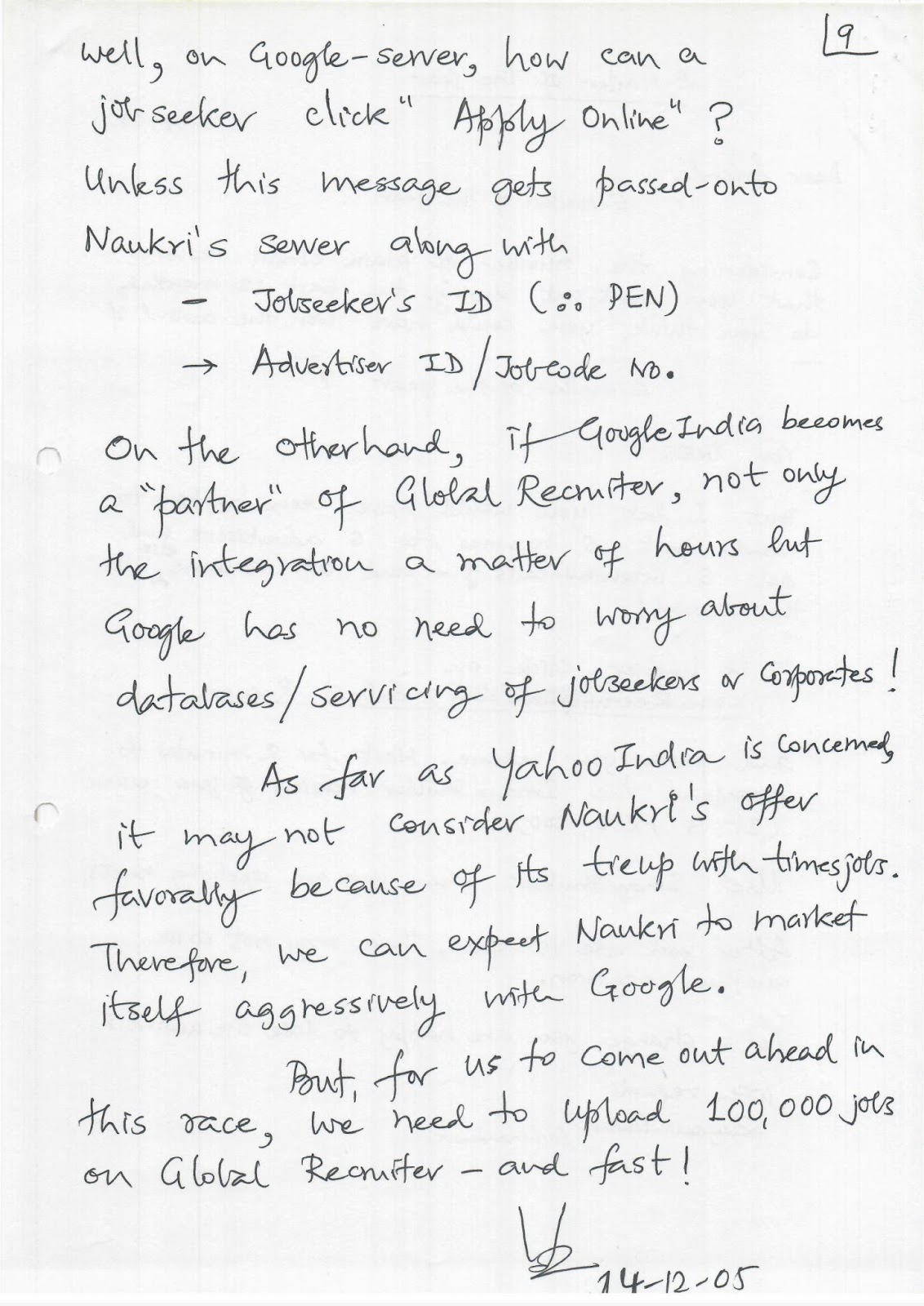
And, unless, Naukri finds a way
to upload its 5 million resumes as
well, on Google-server, how can a
job seeker click "Apply Online"?
Unless this message gets
passed-onto Naukri's server along with
- Jobseeker's ID (i.e. PEN)
- Advertiser ID/Jobcode No.
On the other hand, if Google
India becomes a "partner" of Global Recruiter, not only the
integration a matter of hours but Google has no need to worry about
databases/servicing of jobseekers or corporates!14
As far as Yahoo India is
concerned, it may not consider Naukri's offer favorably because of15
its tieup with timesjobs.16
Therefore, we can expect Naukri
to market itself aggressively with Google.17
But, for us to come out ahead in
this race, we need to upload 100,000 jobs on Global Recruiter - and fast!18
Lady luck, and a wife
Naukri.com's founder on how he
managed to avoid being "a fully-kept man" while building the
country's biggest jobs website
LUNCH WITH BS SANJEEV
BIKHCHANDANI
PHOTOGRAPHER: PRIYANKA PARASHAR
Luck. It's a thought that keeps
coming back while Sanjeev Bikhchandani built Naukri.com, India's largest
entry-level web-based employment service. Unlike his rival, Monster.com's India
offering, https://www.google.com/search?q=JobsAhead.com and Timesjobs.com,
Naukri is an Indian company. Is it that he had the foresight to spot an
incipient opportunity while others didn't? Or is it perseverance, writes Sunil
Jain
We meet at the Royal Plaza, a
Piccadilly in Connaught Place's heart. Bikhchandani's efforts to resemble the
London businessman, whose life is all about lunches and bus in the middle of
the week, have met him with the red coats and a lady that might have strayed by
the Buckingham Palace guards. In any event, he has a long story which
Bikhchandani grew up in Lucknow, moved to Delhi in 1975, which is what led him
to change his name from the original Bikhchandani to Bikhchandani. His wife is
quietly ordered. No booze, as is common with founders, and by an afternoon
meeting, he's a very hot chicory drink, it's very hot indeed, a drink for
starters and grilled fish for both of us.
Bikhchandani's story, or the
sales pitch as he sees it, is pretty well-known now since it has been reported
in all the newspapers, including the ones read by a professor at the University
of Pennsylvania's Wharton School. Bikhchandani quit a comfortable marketing job
at HMM (where he earned Rs 8,000 a month) in 1990 to set up all his own job
ventures. He was initially planning on setting up all the time to look at the
'HBR (Harvard Business Review) on loss-making magazine'. "You're a man
who's looking for a job when you're not looking for a job," he remembers a
company doing the field market research for consumer goods. But, the company
was so broke that after the boss was looking after his wife who had just had a
baby, his sales manager oversaw everybody's personal finances. He'd done School
of Marketing, managed the company's computer SBS computer classes – in early
1990 he was a partner with the company, he got $\text{5\%}$ share. In the
pursuit of this vision of the future, one of his first moves after being
appointed was to persuade his new employer to spend some $\text{₹ 30}$ lakh on
PCs, a filing system and a graphic store and share service.
"We were lucky since the
dotcom bust happened soon after we got funding, but full marks to ICICI, they
never negotiated that valuation, and kept the faith"
The Editor of The Flower and
Fruit News, a monthly supplements, he'd previously made possible to make those
meetings with all their splendor. Mitra — a very smart lady who helped him
raise the money, his wife's sister — was working at the Department of Telecommunications,
the government's official telecommunications service and wasn't confident her
colleagues would get staffers to forward messages. Bikhchandani was left to
fend for himself: his initial offering was a job-database — a lawyer and doctor
could browse for jobs and choose the one they liked. However, he didn't provide
details. The DoT project was approved in 1996, and in 1998, at a visit to IT
Asia, Bikhchandani decided to do a search, rather than just provide the
details. The search facility was a hit, and it led him to do a lot of research
on it, using the DoT's service. The DoT was also very generous, giving him
access to everything, including the service's media mentions. The service was a
hit, and Naukri.com was born.
It wasn't easy: for the first few
years, they didn't make a rupee. “I started thinking I was a fully-kept man. My
wife’s income was the only one in the house,” he says. Then in 1999, JobsAhead
launched the first cricket tournament on the internet, and was the first job
website in India. Naukri.com went public in 2000, raising $\text{₹ 7.2}$ crore.
“It was the first job website to go public. We were lucky since the dotcom bust
happened soon after we got funding, but full marks to ICICI, they never negotiated
that valuation, and kept the faith,” he says.
Since then, the company has done
well, with an annual revenue of $\text{₹ 43}$ crore with a profit of $\text{₹
8.4}$ crore.
Now, running a company of
$\text{770}$ people and facing pressure is a nightmare, but how’s Google’s
search engine, with all its power, affecting Naukri? Bikhchandani, ever the
marketing man, tells you the reason his success has a lot to do with the fact
that, to some degree, he's put all his $\text{₹ 8,000}$ into the business,
which is what Google and Yahoo! did. "This ugly thing called
$\text{Google}$ has done a service. Isn't Naukri dead because Google has
searched for jobs for free? The answer is: the question is: will the average
user of the internet be happy with the results of a simple search for jobs? For
instance, Google might give you a resume for a CEO job at $\text{Citigroup}$
when you searched for an entry-level job."
Bikhchandani is a master
salesman, with an energetic service to both charter his and others' needs. He
says the company’s success, and that of his competitors, comes down to his
willingness to pay, and his willingness to work hard. He also shares his own
search for the answer:
“I have two search engines for
jobs now, one is a paid one, and one is a free one. The free one is for
everyone, and the paid one is only for the companies who pay for it. The free
one is more effective than the paid one, and it is a good way to see how effective
the company is in finding the right person for the job.”
He is also open about the
challenges he faces:
“The Indian newspaper companies
are a nightmare. They have all got their own job websites, and they are all
competing with us. The Hindu, The Times of India, and all the rest of them.
They are all after us, and they all want to take a cut of our profits. I have
to be careful not to let them in the door.”
He is also very clear about the
future:
“I want to be the best job
website in the world. I want to be the company that everyone comes to when they
are looking for a job. I want to be the place where everyone is happy.”
It is clear that Bikhchandani is
a man who knows what he wants and how to get it. He has a great story to tell,
and he is a great salesman.
PERSONAL BUSINESS 9
How to free the slaves from
the webmasters
ALAN CANE
Bradley Horowitz comes to
the web because he loves the freedom he enjoys at Yahoo! (chief executive,
Terry Semel, once said Horowitz was “leading me all the way in the world. He's
got his finger on the pulse of the web, and he's going to make it sing for me.”
He grins, mixing metaphors with an enthusiastic zeal.
Horowitz, a California-based
Yahoo, now more than 10 years old, has invented the technology for the next
generation of the web, but, in recent years, Google has been his rival, by the
upstart Google, contributor of the verb "to Google" to the English
language, and by an increasingly popular Microsoft. Now it is fighting on
several multiple fronts, not least those of its core business: web search.
Horowitz, an entrepreneurial
graduate of the Wharton School, co-founded Virage, a media indexing company,
and worked for the UK Group Autonomy two years before he became technology
director, search and messaging group, in 2004. Ago. It is a gregarious little
guy who reflects the speed that characterises the time the way society
interprets. A man who wants to regain its former lustre.
His first priority is to usher in
a new concept of web search. He is part of a part of a Google or Microsoft's
MSN will be augmented, if not wholly replaced, by a personalised expertise and
experience of the web. This is what Yahoo calls this, “social search,” which
goes a long way towards defining characteristic of the next generation of web
search tools.
In pursuit of this vision of the
future, one of his first moves after being appointed was to persuade his new
employers to spend some $\text{\$ 30}$ m on “Flickr,” an online photographic
store and share service, and a social network technology that makes it easy for
friends to create a personal hierarchy of favourite images.
The result is an innovative, an
experimental service based on the technology called by web 2.0, which
allows customers to tag their favourite websites and share them to 50 websites
or to share with other people's friends: two degrees of separation and a great
deal of it. Horowitz gives the example of typing "bicycle" into a
corporate search engine that produces millions of results, but the same search
he gives to you, for your neighbour and the neighbour's neighbour, across the
world. MyWeb 2.0, or social search, allows content that you have already tagged
as being of interest, or as being selected by Friends and acquaintances. It is
the equivalent of "Who knows your tastes? "Who knows a good bike
shop?"
To Yahoo, it is the fourth
chapter in the web search story.
The first chapter was Yahoo!'s founders, the Stanford University graduates,
David Filo and Jerry Yang, was a general directory, a manually prepared
classification of all the web's sites and services.
As the web expanded, this became
impossibly laborious, however, and the second chapter was heralded by Google’s
new, automated search engines such as Alta Vista, HotBot and Inktomi, which
sent out software robots to crawl the web. They did it by garner pages of
information on content, on text, on images, and they used conventional text
indexing.
The advent of page ranking, for
which Google devised a means to classify, marked chapter three: a new
engineering of modern search.
Rather than simply representing
the undifferentiated mass of pages of the web, the page ranking software sorted
the information, or pages, to bring the most significant first. This is still
the core of the computer giant's home page at the top of the list.
But, as Horowitz points out, the
hierarchy is decided by the webmasters, the controllers of website content:
"We are slaves to the internet by proxy on what's important. We vote on
what's important, we are slaves to the webmaster's idea of what is important."
He goes on: "This next phase
is our second and social search means that we'll move from a webmaster's
privilege of voting on what's important to a user's right to pose that so
communities and groups can leverage that information into social search."
The key is a consensus-based social search on open standards in order to spread
the information and create a 'who's who' environment.
Summary Table
|
File Name |
Topic/Subject |
Key People Mentioned |
Key Companies/Websites |
|
Scan_0010.jpg |
Naukri.com's founder, Sanjeev
Bikhchandani, discusses his journey and the challenges of building the
company. |
Sanjeev Bikhchandani, Sunil
Jain, Mitra |
Naukri.com, Monster.com,
https://www.google.com/search?q=JobsAhead.com, Timesjobs.com, ICICI, Google,
Yahoo! |
|
Scan_0011.jpg |
How to "free the slaves
from the webmasters" by moving from conventional search to "social
search" (Web 2.0). |




No comments:
Post a Comment