
Employability
Profile (04-04-06)
Rajeev
→ Vikram
cc:
Rahul → Saurabh → Pranav
Date:
04-04-06
EMPLOYABILITY
PROFILE
This
is further to my note yesterday re: Antecedent Check Form.
In
the entire recruitment process, “antecedent checking” is a very important
element.
It
is also the most neglected / most overlooked element because:
- Checking
antecedents of candidates is a time-consuming process.
If
you need to check antecedents of hundreds of candidates (in order to hire just
2 or 3), then it is an almost daunting job.
In
fact, because of this reason, many verification companies have come up.
Big employers subcontract this work to such specialist companies.
- Antecedent
checking requires great skill — to get the truth
out of past employers is not an easy job!
- Most
antecedent checking is currently being done offline.
You
either phone up the past employers of the candidate concerned, or send a form
to be filled up and returned to you.
But
the problem is:
From
that candidate’s resume, there is no way to find out:
- Postal
address of past employers
- Phone
numbers of the HR managers (of past employers)
It
takes a lot of time to find out this info (from other sources).
If
you manage to find addresses, you must:
a)
Know whom (which person) to send the form
b)
Fill in candidate’s name and some other relevant data (about that candidate) in
the Form before you can hand over to courier.
Employability
Profile (continued)
- If
you manage to get some response from 3 past employers (about a given
candidate), then you must learn to “collate” the data imaginatively, in
order to make “sense” — especially if:
- Opinions/views
expressed by past employers are subjective / qualitative / descriptive
and cannot be simply “added-up” arithmetically!
- Opinions/views
expressed are diametrically opposite! Which one should you believe
and which one not? (You will need very imaginative skills — like a
forensic expert? — to read between the lines!)
- HR
Manager of “respondent” (past employer) company would be tempted to put
away the printed/faxed form at the bottom of his “Pending Matters” file —
and may never get around to attend to it (or, fill in typed details and
give to secretary to post it).
- If
a week passes, he knows it is of no use to send it anyway!
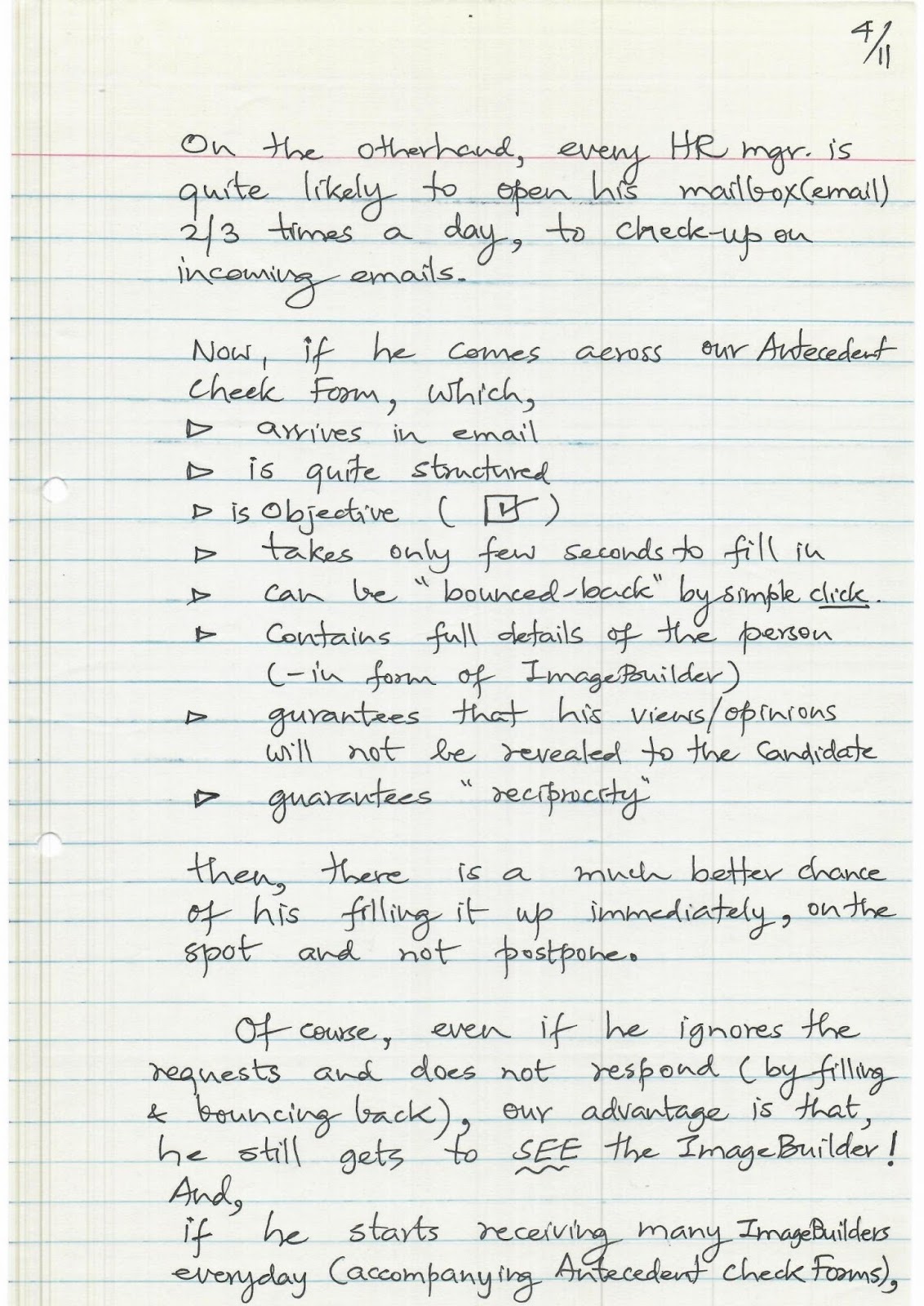
On
the other hand, every HR Manager is quite likely to open his mailbox (email)
2–3 times a day to check up on incoming emails.
Now,
if he comes across our Antecedent Check Form, which:
- Arrives
in email,
- Is
quite structured,
- Is
objective,
- Takes
only a few seconds to fill in,
- Can
be bounced back by simple click,
- Contains
full details of the person (in form of ImageBuilder™),
- Guarantees
that his views/opinions will not be revealed to the candidate,
- Guarantees
reciprocity,
Then
there is a minute better chance of his filling it up immediately, on the spot —
and not postponing.
Of
course, even if he ignores the request and does not respond (by filling &
bouncing back), our advantage is that he still gets to see the
ImageBuilder™!
And,
if he starts receiving many ImageBuilders every day (accompanying Antecedent
Check Forms), ...
Employability
Profile (continued)
He
may see the “superiority” of ImageBuilder™ over the plain text resumes.
In
such a case, hopefully:
- He
will visit GlobalRecruiter / IndiaRecruiter and decide to register.
- He
may insist that jobseekers must only send ImageBuilders to him.
- He
may himself start using our Antecedent Check Service (for using
which, of course, he will need to register and become a subscriber).
Of
course, for responding to a request (for Antecedent Check) from some HR
Manager, he need not be a subscriber.
The return traffic does not need subscription. But if he cares to
respond, he may also want to use his Reciprocal Rights by himself
becoming a requester!
This,
then, is PHASE I
(viz:
sending Antecedent Check requests online & getting feedback by email).
STEP
#2 (Software Logic)
Our
software calculates the score based on ticks ✔.
Obviously,
S/W will need to be capable of reading ticks ✔.
- It
will first read the number of boxes (a) ticked ✔ in the first
column and multiply by 5.
- Next,
it will read the number of boxes (b) ticked ✔ in the middle
column and multiply by 3.
- Next,
it will add up (a + b).
- Next,
it will calculate c = 20 – (a + b).
- Next,
it will multiply (c × 1).
- Next,
it will add up all 3 scores.
The
S/W will repeat this process every time an Antecedent Check form entry is duly
filled in.
It
will store all A/C forms candidate-wise.
For each candidate, S/W will create a summary table (as shown in Step
#2) and calculate Average Score.
This
will be a continuous / dynamic process.
Employability
Profile (continued)
STEP
#3
S/W
will create a tabulation of “Avg. Raw Scores” of all candidates, as shown on Step
#3.
STEP
#4
From
this database, S/W will draw a Frequency Distribution graph (using
standard / readily available statistical packages — perhaps already used in
Gunthine).
STEP
#5
When
an HR Manager conducts “Resume Search” (whether conventional or advanced),
resume search results are displayed in the manner of a tabulated summary, as
shown in Step #5.
Current display table does not show the last 4 columns. These will need
to be added.
The results will be arranged in the descending order of Employability
Profile Percentile Score (i.e., employees having highest percentile score
for employability at the top).
(Newspaper
clipping attached: “Ranking system for Yahoo Finance,” TOI, 05-04-2006)
Through
Employability Profile, we are trying to do exactly what Yahoo is trying to do
as shown above, viz: getting community to rate — what Yahoo calls “social
consensus”, but with several important differences, viz:
- Rating
is not on a simple scale of 1 to 5.
- It
is much more refined, based on 20 parameters and three levels (5
/ 3 / 1) of scoring.
- Rating
is not just by anybody (as in case of Monster ratings — job
applicants of employer company).
It is by HR Managers of the candidate’s past employers who presumably have known him in depth. - Plotting
of a Percentile Graph converts a simple stand-alone raw
score into Relative Ranking, so now an HR Manager has a
“perspective” of the relative standing of various candidates.
Instead of absolute “Good” or “Bad”, everything is relative / related to something.
Employability
Profile (continued)
- Being
“relative” within a given population of executives (on a given date), our
rating is dynamic (not static).
It
continuously changes every time:
→
more forms are arriving about other candidates, or
→
more forms are arriving about the same candidate.
- By
dividing the Employability Profile Graph into 4 distinct zones –
with our own interpretations shown in it – we are converting this
system/feature into a true Recommendation System.
Since
our “Recommendation System” is based on collective / normalized opinions
of a peer group (viz: HR co-professionals), an HR manager will feel very
comfortable/safe in going along with the consensus while deciding to hire a
candidate.
He
cannot be faulted for his hiring decision!
Thus,
Employability Profile Graphs we are giving to the HR managers are a very
powerful
→
“Aid” in hiring decisions.
→
“Tool” in defending his hiring decisions!
It
is like,
Can
you find fault with a bank manager for granting a loan to a company rated AAA+
by CRISIL / S&P / MOODY’S?
And
this is not a case of “rating” by a single / biased person.
It
is a rating by a group of past employers, where statistically, bias (if any)
will get more & more diluted / insignificant as time passes!
If
this application proves to be a “hit” with HR managers, it has the potential to
catapult us ahead of Monster / Naukri / TimesJobs!
Let
us do!
(Signed)
05-Apr-2006
Raw
Score Data Example
Candidates
for whom Antecedent Forms have been received from past employers as of 04-04-06
|
Candidate |
Mahore |
Patel |
Venkat |
Swamy |
Dhingra |
|
(A)
Total No. of Instances of Feedback |
29 |
15 |
20 |
25 |
40 |
|
(B)
Grand Total of Scores |
1859 |
750 |
900 |
1750 |
1400 |
|
RAW
Average Score – B/A (for this candidate as of 04-04-06) |
64 |
50 |
45 |
70 |
35 |
Narrative
below the table:
Once
we have such RAW SCORE data about 10,000 candidates,
it
would be quite easy to plot a FREQUENCY DISTRIBUTION GRAPH
(for
the Average Raw Scores)
and
calculate the Percentile Score for each and every candidate.
Then
this percentile score can be superimposed (as in case of Function
Profile Graph).
(Illustrated
sketch of a bell curve with Step #4 reference.)
GlobalRecruiter
Resume-Search Display Layout
Global
Recruiter
Resume-Search
/ Short Display Results
|
Select |
PEN |
Name |
City |
Exp |
Edu
Qualif |
Current
Designation |
Current
Function |
No.
of times his resume was viewed |
Candidate’s
Percentile Score for FUNCTION Profile |
Candidate’s
Percentile Score for EMPLOYABILITY Profile |
Click
to View Image Profile |
|
82 |
79 |
☐ |
|||||||||
|
78 |
75 |
☐ |
|||||||||
|
72 |
69 |
☐ |
|||||||||
|
68 |
65 |
☐ |
|||||||||
|
62 |
56 |
☐ |
Employability
Profile Explanation
This
profile is generated based on Antecedent Check Forms filled by the past
employers of the concerned candidate.
These
antecedent checks ensure the highest possible employee integrity assessment on
the basis of Reciprocity between our Subscribers (Employers).
Clicking
the Antecedent Feedback opens a detailed analysis of the candidate’s
professional reputation.
GlobalRecruiter
will never reveal individual identities or feedback sources to any employee.
When you select Employability Profile, you will see the following
analytics:
Employability
Profile Graph (Illustrated Below)
A
Human Resource Analytics of GlobalRecruiter.net
|
Field |
Value |
|
Date |
(blank) |
|
PEN |
(blank) |
|
Executive
Name |
(blank) |
|
Avg.
Raw Score |
(blank) |
|
Employability
Percentile |
(blank) |
(Bell
curve illustration labelled with ZONE-A, ZONE-B, ZONE-C, ZONE-D, mapping
percentile
istributions
and HR interpretations.)
Bottom
note:
“This
feature will auto-populate upon completion of minimum feedback threshold; until
then, graph remains blank.”




No comments:
Post a Comment