
“Freedom
of Choice & Recommendation Systems”
(TOI
clipping dated 19-07-06 attached)
Pranav
→ Saurabh → Rahul → HCP
If
any of you want to read more about this issue, I can bring from home a good
book on the subject titled:
“A Paradox of Choices.”
When
(someday) we put into place
Recommendation Systems
→ for Jobseekers (Jobs Recommended)
→ for Employers (Resumes Recommended)
Then,
we are venturing into this “territory.”
We are certainly NOT deciding (which job to apply to / which candidate to
shortlist) — but we are helping jobseekers and HR managers to quickly “zero-in”
on a fewer options (choices), which makes it easy for them to decide.
Google/Yahoo
fall miserably on this!
“Buying
What Others Have Bought”
Rajeev
– Reji – Abhi
16-08-05
Earlier
I have sent you a note about showing a counter in job search. I suggest a
similar counter in the resume search too.
In
short display, these will look as follows:
JOB-SEARCH
|
Job/Advt
Details |
How
many have looked at this ad before? |
While
conducting job search |
Having
received as SMS job alert |
Partner
websites |
RESUME-SEARCH
|
Resume
Details |
How
many recruitment managers have searched this resume so far? |
While
conducting resume search |
Having
received as email job alert |
Partner
websites |
I
will explain in person WHY such display is absolutely MUST.
(Below
sketch)
| PEN Name | Resume Viewed | Read this Application | Forget |
“Buying
What Others Have Bought” (contd.)
As
far as Job-Search Display is concerned, I have explained the importance
of Counter-Window in my note (Aug 16).
What others have chosen?
But
this concept is even far more important when it comes to resumes /
resume-search.
With
the economy booming, there is a mad scramble to hire good candidates and hire
them before your competitor makes them a better offer!
But
how can an HR manager conclude, simply by looking at the Resume-Search
Display, that
–
“XYZ seems like a GOOD candidate.”
– “ABC looks like an AVERAGE candidate.”
– “LMJ is a POOR candidate.”
To
reach such a conclusion, he would need to
▸ first download that resume
▸ next read it …
But
when you are presented with hundreds of resumes in a short display, which one
to open / read and which one to skip?
If
you open each (one-by-one) to read, you may end up wasting a lot of your time.
The
huge number of choices/options presented could
▸ empty you
▸ confuse you
▸ paralyze you
You
may even “give up” after opening and going through 20–30 resumes.
And
once you “give up” and stop opening further resumes, guilty-consciousness
takes over!
Now
you feel guilty that you did not open ALL resumes and possibly the
better/best candidate you missed out!
You blame yourself for not having opened 640 resumes that were listed in
short display — even though you know fully well that it was impractical to open
& read 640 resumes in order to find/locate 36 which had higher
probability of being “Good.”
This
is where the counters shown on-display come in handy.
“Seen”
/ “downloaded” / “received” by a large no. of HR mgrs, then I, as another HR
mgr, can reasonably conclude that it must be a good — they also would be
many HR mgrs who took the trouble to download & read it?
To
me, as an HR mgr, this is the clear proof that THIS is a GOOD resume.
The
large “Number” inside the WINDOW speaks for itself!
So,
now I am on safe ground. If I download / open / read only those
resumes against which I see a LARGE number, I am selecting a quite sound
/ rational one. I don’t need to worry for those resumes against which there
is a SMALL number.
Another
angle:
If
a resume has figured again & again, has been delivered again & again,
as RAM / RAS,
then it is a CLEAR proof that a large no. of HR managers are looking for
exactly such a person!
(Note:
“Multiple Consignments for it confirm requirement” written in margin)
Obviously
this particular resume was found to be a perfect match against Resume
Preference forms filled up by a large no. of HR mgrs.
Obviously
this resume met the requirement criteria specified by a large no. of the mgrs.
A
guy like this seems to be in GREAT DEMAND!
And
this LARGE number appearing in the window is somewhat of POPULARITY INDEX!
(like Indian Idol!)
He
has scored MAX. VOTES from peers — professional HR mgrs.
So,
I am on a perfectly safe ground, if I too VOTE for him (mentally).
Naturally,
so many HR mgrs could not be wrong in their judgement — their collective
judgement expressed by a large no.
With
this kind of thinking, I am pretty sure that, the more a —
Resume
gets clicked / downloaded / opened,
the more it is LIKELY to get clicked!
It
can become a self-fulfilling prophecy.
But
how can we get this process into motion?
To
begin with, the probability that any particular resume gets short-listed during
a resume search (and gets opened / clicked) is quite lower — especially if
there are a large no. of resumes of that particular skill / exp / background /
Ind / function etc.
Again,
if the resume was posted only 2 days back, the counter may show ZERO.
If
it was posted 2 months back, it may show 19.
And
if it was posted ONE YEAR back, it may show 28.
What
I mean is,
The probability of a Large No., solely due to Resume seen (count),
is low.
It can only increase with time.
But,
this “no.” under RAM / RAS counter could be large (or at least respectable)
within 2/3 days of resume getting posted!
If
the resume belongs to a person who is in reasonable DEMAND, then it is
quite possible that a no. of HR mgrs have submitted similar
“Resume
Preferences”
(for getting RAM-RAS)
on different partner websites.
In
which case, this fellow’s Resume Alert will get delivered to all these
HR mgrs within first 2/3 days.
And will continue to get delivered as each new
“Resume Preference” form gets filled & submitted on websites.
So,
even if HR mgrs are not conducting resume search online and not short-listing
this resume, they are still getting a “resume alert” under RAM / RAS,
and the counter goes up each time.
Then
someday, we will find a method to convey to each candidate his
POPULARITY INDEX.
Abhi
→ Rajeev → Reiji
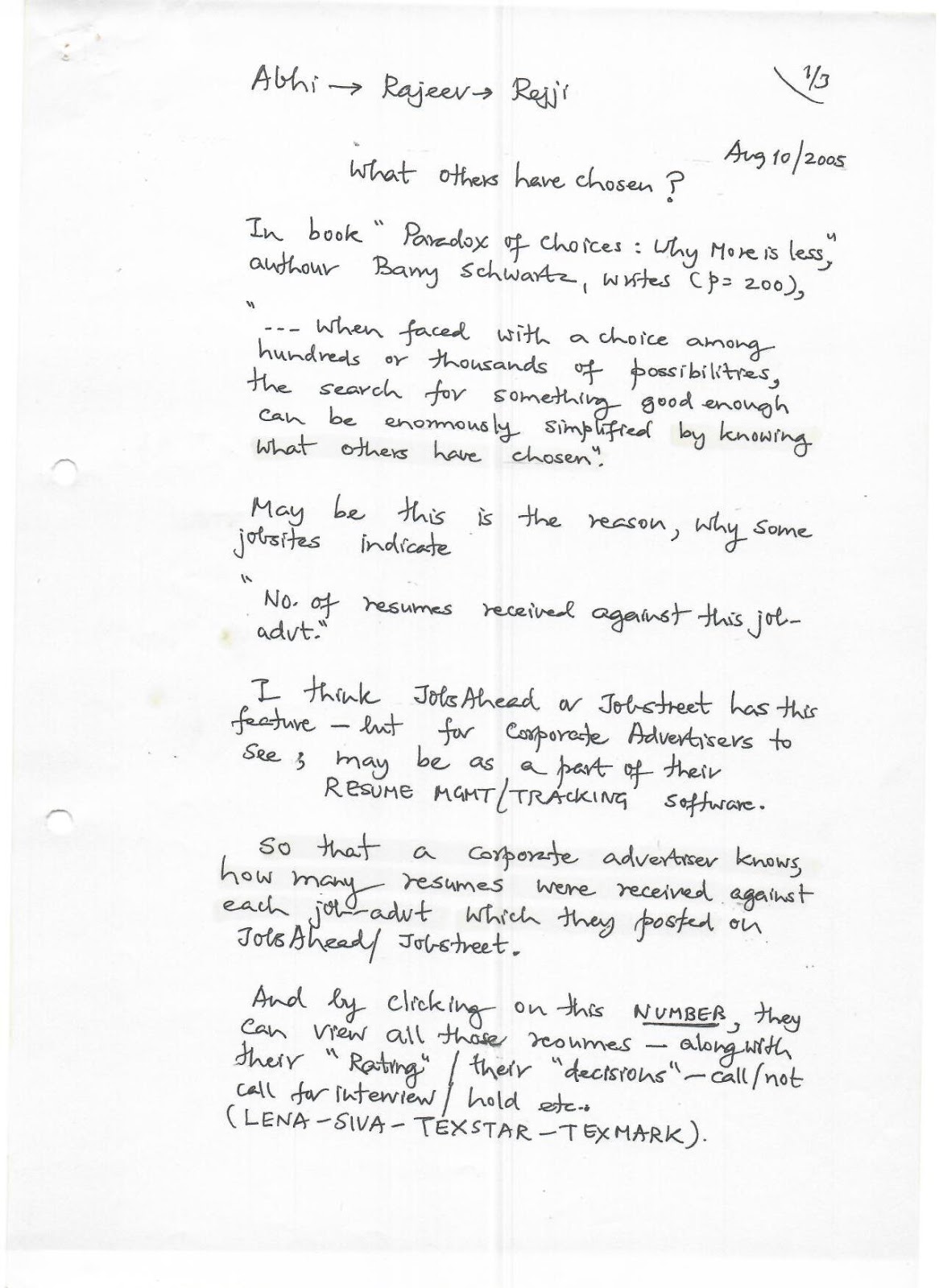
Aug 10 / 2005
What
others have chosen?
In
book “Paradox of Choice: Why More is Less,” author Barry Schwartz,
writes (p.72, 2005):
“…
when faced with a choice among hundreds or thousands of possibilities, the
search for something good enough can be enormously simplified by knowing what
others have chosen.”
Maybe
this is the reason why some job sites indicate
No. of resumes received against this job ad.
I
think JobsAhead or JobStreet has this feature – but for Corporate Advertisers
to see! Maybe as part of their
RESUME MGMT / TRACKING software.
So
that a Corporate Advertiser knows how many resumes were received against each
job ad which they posted on JobsAhead / JobStreet.
And
by clicking on this NUMBER, they can view all those resumes – along with
their “Rating” / their “decisions” – call not call / shortlisted / rejected /
etc.
(LEENA – SUVA – TEXSTAR – T. MARK)
I
believe you are planning to incorporate some such feature in Global
Recruiter.
If our feature turns out to be superior (to JobsAhead / JobStreet’s), then our
partner websites will enjoy a definite competitive advantage over them.
In India, this is very desirable.
But
3–4 years ago, we had tried to incorporate somewhat similar feature on 3pJobs.com,
wherein:
- There
was a WINDOW ( ) against each & every job-advt posted on
3pJobs.
- During
job searches, some job-advt(s) would get shortlisted.
|
Sr |
Job
Advt No |
Advertiser
Name |
Position |
Mgr-Spec |
Window |
|
236 |
23 |
||||
|
1283 |
42 |
Now,
if a jobseeker clicked on any of these (to read FULL advt), then the counter in
the window would go up — indicating how many jobseekers had “opened” /
“viewed” this job-advt.
The
rationale / reasoning was simple:
If
the “no.” (in the counter window) is large/respectable, the next candidate will
be much more likely to click on that advt — out of curiosity & out of
belief that
“So
many jobseekers can’t be all wrong to have clicked & opened this advt.”
The
idea was to create a self-fulfilling prophecy whereby
- The
more clicked / viewed an advt, the more it will get clicked again!
There
would be a “Herd Mentality” effect.
This
mentality would set into motion a
VIRTUOUS
CIRCLE —
The
more the no. of past clicks, the more the no. of future clicks.
This
feature can also be incorporated in RESUME SEARCH.
A
HR manager is bound to click/open that resume which he sees/knows has been
opened earlier many times by his co-professionals!
Let
us do this.
Amazon-type
"Recommendation System"
- For
Jobseekers
To
recommend to jobseeker, what "search criteria" to select, during his
next "job-search".
- For
Corporates
To
recommend to HR mgr, what "search criteria" to select, during his
next "resume-search".
This
is fairly simple.
Let
us first take Jobseeker's case.
We
have already decided to enable him to view his own:
- Job-Search
History
- Apply
Online History
For
conducting a jobsearch, he has to select, "Ind / Func / Desig-level /
City".
When
he applies online, he is applying against a specific Job Advt.
Once
again, while posting a job, a HR manager has got to select — Ind - Func -
Desig. level - City".
In
anycase, for Job-Search History & Apply Online History, we have to
capture/store some fields.
Let
us also store fields for "Ind - Func - Desig. level - City"
everytime/eachtime, a jobseeker conducts a job-search or applies Online against
an advt.
This
capturing/aggregating should be ongoing/dynamic process.
After
a while, we would get to see a tabulation like follows:
|
Total
No. of Job Searches so far: |
54 |
|
Total
No. of Apply Online so far: |
46/100 |
|
Ind.
selected |
Func.
selected |
Desig.
selected |
City
selected |
|
Name |
NO |
Name |
NO |
|
Pharma |
64 |
Sales |
72 |
|
Chemical |
26 |
Mktg |
16 |
|
Packaging |
10 |
Service |
12 |
|
Total |
100 |
100 |
This
tabulation is strictly for our own viewing (not even by partner websites). In
fact, even we would not want to see it!
But,
now we know the probabilities with which he is likely to select
during his next job-search:
- Industry
= Pharma $\rightarrow$ 0.64
- Function
= Sales $\rightarrow$ 0.72
- Design.
Level = GM $\rightarrow$ 0.68
- City
= Mumbai $\rightarrow$ 0.58
As
soon as he logs in for "Job-Search", the search-box will get CUSTOMIZED
& get displayed, as follows:
Dear
Ajay, your past search history suggests your preference for Search criteria,
shown below. Of course, feel free to modify.
JOB
SEARCH
|
Field |
Input
Area/Dropdown |
Note |
|
Keywords |
[Text
box] |
|
|
Min
Exp |
[Text
box] |
|
|
Industry |
[Dropdown]
Pharma (64), Chemical (26), Packaging (10) |
*
Your past preferences, arranged in descending order |
|
Function |
[Dropdown]
Sales (72), Mktg (16), Service (12) |
*
Your past preferences, arranged in descending order |
|
Desig.
Level |
[Dropdown]
GM, VP, CEO |
|
|
City |
[Dropdown]
Mumbai, Delhi, Chennai |
|
|
[Submit
button] |
For
the jobseeker concerned, this will appear amazing! This is "personalization/customization"
at best.
Now
the jobseeker knows WE CARE, we are here to make his life easy.
This
is exactly what Amazon does—and it is NOT rocket-science!
It
is a good thing for us that, as of now, no other jobsite does this.
If
we do this, it will set us apart, differentiate us. And unless we
differentiate, we cannot attract (would-be) partners.
They
(would-be partners) need such features to divert Jobseekers & Corporates
from Monster/Naukri.
We
can, similarly, "Recommend" Ind / Func / Desig. level / cities
etc. to a HR manager based on his past "Resume Search
History".
In
Resume Search U/I, as soon as HR mgr logs-in, we can fill-in / really
re-arrange the dropdowns, with most-searched names at the top (the
relevant choplists).
This
can be outsourced to same person who will develop various ADMIN
screens / software / displays.
We
can also accumulate/aggregate "Keywords" used by jobseekers
during their job-searches & calculate "frequency of usage"
& then display those (with high frequency) in their "Keyword
Box" when they next log in.
Similarly,
when a jobseeker conducts his first ever (very first) jobsearch, as soon
as he logs-in, we can fill-in his job-preferences (Ind / Func /
Desig. level / City) into the respective jobsearch fields. This is quite
easy, and our "recommendation-system" starts from his very
first jobsearch!
Here
is the text conversion from the uploaded images:
📈
Enhancing the Recommendation System
Keyword
Aggregation
We
can also accumulate/aggregate "Keywords" used by
jobseekers during their job-searches & calculate "frequency of
usage" & then display those (with high frequency) in
their "Keyword Box" when they next log in.
Similarly,
when a jobseeker conducts his first ever (very first) jobsearch, as
soon as he logs-in, we can fill-in his job-preferences (Ind
/ Func / Desig. level / City) into the respective jobsearch fields. This is
quite easy, and our "recommendation-system" starts
from his very first jobsearch!
Click
Stream Analysis and Prediction
Names
(User registration flow example, connected to HCL news article context):
- Saurabh
- Yogesh
- Rahul
- Swati
- Sonal
Click
Stream Analysis
- Content
Analysis = "Click Stream
Analysis" to calculate the "frequency" of
clicking of each link.
- NOT
difficult to "predict" if frequency of clicking
of each link/choosing of each field-value, is stored in database
& probabilities re-calculated everytime.
- e.g. Post
Job - Cum - Resume Search
A
Corporate Subscriber will repeatedly:
- a.
type, Post "vacancy" / Edit "keywords" / Job
Descript
- b.
click on: Industry , Function , Desig. level ,
City , etc. etc.
Since
most job-advts. (in any company) gets repeated again & again & again
(only frequency/interval may vary), it is not difficult to figure out
"trends/patterns" — then claim to "Predict"!
Date
stamp: 20/12/06
To:
Rajeev cc: Vikram cc: Rahul Date: 05/02/06
I
have not come across any Indian jobsites which use Click Stream data to
analyse and present/display the results for the benefit of jobseekers and
employers.
Thru
ARM ("clicking of 'Feedback Links'") we have made a small beginning.
But
this can be said to be "Tip of the (Analytics) Iceberg".
We
can do lot more - as shown in enclosed pages.
Most
of this is quite SIMPLE/STRAIGHT FORWARD.
Wherever
there is a "droplist", count every click and add-up to
aggregate.
Have
a Separate Data Table for each Droplist.
Droplists,
themselves are first to be separated into:
- Droplists
in "Jobseeker U/I"
- Droplists
in "Employer U/I"
Arrange
all Data-Tables in descending order of "No. of accumulated clicks".
Such
"descending order" will facilitate On-the-fly Generation
of:
- Bar
charts
- PIE
charts
- Distribution
Curves This is also Recruitguru's LOGO!
Now you see the reason for its selection as our Logo!
If
you type in Google's Search bar "Clickstream Analysis Software",
you will get 156 results!
Lots
of expensive commercial S/W are available with hundreds of features — which
we don't need.
Maybe
even Google's "Web Analytics" (free S/W) which Athul/Reiji are
supposed to have installed on all of our websites, could also do.
What
I am suggesting, I don't know.
In
any case, Click Stream Analysis to generate lots of Charts, is a LOW
PRIORITY.
(Even
though I consider this feature/application as VERY IMPORTANT from the
viewpoint that it will):
- "Differentiate"
Global Recruiters from Monster/Naukri/Timesjobs
& place us in a class by itself.
- Motivate
a lot of jobsites to become our partner websites.
They can use this feature to "Sell" subscriptions to Corporate
employers.
- Attract
a lot of jobseekers/employers to subscribe/register
on partner websites.
- Generate
for us/our partners a lot of additional revenue,
if we "price" each graph/piechart/barchart/frequency diagram
VIEWING (click open) at Rs. 5!
Questions
- Which
no jobseeker or employer has ever bothered to ask, because they know/think
that there is no jobsite that can provide "answers" to
their questions!
Q:
- During
a jobsearch what "Industries" are jobseekers Clicking
on?
- Put
it other way, what "Industries" are popular/sought-after
by jobseekers?
- What
is the "Popularity Index" of any given "Industry",
arrived/derived from CLICK-STREAM DATA of Jobseekers?
Such
a question could be easily answered as shown in ANNEX: A.
Similar/identical
questions can also be easily answered, in relation to
- Which
"Functions" are most/least popular
- "Desig.
Level"
- "City"
- from
"ARCHIVAL METHOD"
- Which
"Actual Desig" are most/least popular
- "Companies"
This
is all about "SUPPLY-SIDE"
(jobseekers'
"database of intentions")
One
can carry-out a similar exercise
with
regard to "DEMAND-SIDE"
i.e.
What
are the intentions of EMPLOYERS?
(i.e.
The Demand-Side).
Questions
(that could be answered thru
such
Demand Analytics) could be:
Q:
Candidates
having background (exp)
$\rightarrow$
in ABC industry are in big demand
$\rightarrow$
in XYZ " " " least ".
Maxm
jobs are in ABC/HJK cities Minm " " " LMN/OPQ
" (see our PIE-CHARTS in WWJ "Where are the
jobs?")
Q:
What is the "most-desired" Edu. level that employers
are asking for? For which Edu. level, there is no demand?
Q:
Experience (No. of years) demanded by Employers
U/I
= JOB SEARCH / CONVENTIONAL
ANNEX:
A
05/02/06
Search
Parameter = INDUSTRY
|
Search
Date |
Search
By (PEN) |
Search
Serial No. |
Adit |
Agri |
Ariliny |
Auto |
Banking |
Beverage |
|
1 |
||||||||
|
2 |
||||||||
|
3 |
||||||||
|
4 |
||||||||
What
are we trying to find out?
- During
Conventional Jobsearch, what "Industries" are
jobseekers clicking on.
What
can Employers/Jobseekers conclude from such an analysis?
- Which
"Industries" are popular/sought-after by
jobseekers? $\rightarrow$ kind of "Popularity Index of Ind."
The
display can be
- Bar
charts * Simple Tabulations (in
descending order)
- Pie
chart
There
are altogether
- 10
user Interfaces
- 10
search-parameters
Of
course, not all U/I have all Search - criteria. Nor are all DROP
LISTS.
Which
means, altogether there could be 70/80 such TABLES, in which, we
could compile/aggregate "CLICK-STREAM" data, on a continuous/ongoing
basis.
Once-a-day
each DATA-TABLE could be Converted into a beautiful/colourful
chart/graph with appropriate "TITLE/HEADING & BASIS
(PERIOD/NO.S)" (Like "Where Are the Jobs?")
$$8943$$
|
23 |
12 |
44 |
612 |
865 |
212 |
- Popular
Industries may feel confident that they
should not have difficulty in finding enough/competent candidates
since their Indus is in such great demand. Conversely, least 'popular'
Industries may realize that, to attract enough good candidates,
they would need to revise their Compensation/perks/benefits/designations
etc.




No comments:
Post a Comment