DIGITAL BIOLOGY Peter
Bentley
.... By understanding the
solutions of nature and using them to solve our own problems, we have found a
whole new class of computation, a whole new way of using computers.
.... These new software
techniques will provide us with invaluable assistance from their digital
universes. They will find us information $\mathbf{\dots}$ they will design
new products for us, create art and compose music. They will have originality,
creativity, and the ability to think for themselves $\mathbf{\dots}$ Using the
methods of digital biology, we have achieved all of these feats.
.... But it seems almost certain
that the first forms of alien life we see will be not through telescopes but
through the windows of our computer screens into digital universes. The first
person to hold a conversation with an alien intelligence will not be an
astronaut, it will be a compu1ter scientist or computational
neuroscientist, talking to an evolved digital neural network.
.... natural and digital biology
follow the same processes, just in different universes.
The Universe and the ripple-like
things within it were destined to an eternity of pointless, mindless existence
and destruction.
[ My comments: This is how Hindu
Vedas described, both the universe and the "Atma"
- Anadi (without a beginning)
- Anant (without an end)
- Shashwat (permanent)
There are many universes that
coexist with or overlap our own. The universe of sound is one as is the
universe of ideas. The digital universe of the computer is another.
.... Nevertheless, there is more
to the Universe than the things we can see or feel.
Light travels very fast, but
never faster than a particular speed limit.
[ This too, has been proved
wrong, a few months ago! ] $\mathbf{\dots}$ April 02.
[ And now, by 01-01-04 (today),
Scientists have succeeded in
- Stopping light in its track!
- Reach its "destinatron", even before it
has left its "source"!
There are many other things we
know about the Universe that are equally hard to accept $\mathbf{\dots}$ the
fact that time does not flow, for example $\mathbf{\dots}$ We exist in
spacetime $\mathbf{\dots}$ a four dimensional Universe comprising all locations
and all times.
.... from a single point in space
$\mathbf{\dots}$ Before the bang, there was no space or time $\mathbf{\dots}$
we are not sure where it came from.
[ It is Anadi $\mathbf{\dots}$
without a beginning, without an origin. ]
We shall make it into a torus:
anything that goes too far to the right finds itself on the left, anything
moving too far to the bottom will end up at the top, and anything existing
toward the end of the Universe (in terms of time), will end up at the beginning.
[ Ana2di / Anant ].
A Universe cannot exist without
laws. Laws define the fundamental properties of the Universe, including its
existence. Universes are made from laws.
If Something, then Outcome.
$\mathbf{\dots}$ every outcome depends on Something. Without that
something, the outcome would never happen. With it, the outcome will always
happen. Every outcome is caused by a something.
The point is that all rules
specify that outcomes must depend on something. If they don't, they are not
rules.... If energy exists, it can never be lost, only transformed.
The laws of the null universe
are simple $\mathbf{\dots}$ there are none. It has no energy, nothing,
with no behavior. It is a universe without a box and without any contents. It
is nothing.
[ Hindu scriptures also describe
"Atma" as being "Nirguna" i.e. without any
"properties". ]
Here are some examples of answers
that do explain the cause of our universe:
- A chaotic universe prior to ours had a rule
that resulted in the creation of our universe
[ What "caused"
this chaotic Universe to come into existence ? ]
This viewpoint suggests that
ideas, concepts, even catchy tunes exist like parasites in our minds. We call
them memes, and the ones that we favor become more numerous, while the memes we
dislike slowly fade away.
Because the collection of rules
that define this little digital universe is known as a computer program....
Computers are machines that can behave in any way you like.... we use them to
behave in ways that are beneficial to us.... A computer program is the set of
instructions that give the computer a behavior.... Every computer program is
essentially a collection of rules that defines what can exist and provides a
set of behaviors. In other words, each computer program defines a new digital
universe.
When the computer runs a program
and those behavior-defining rules are executed, the computer becomes a Universe
generator. The program defines the laws of the digital universe, and the
computer causes that universe to come into being.
Just as a finite number of
different notes can be used to produce an infinite number of different
melodies, a finite number of different instructions can be used to generate an
infinite number of behaviors.
So we define our digital
universes using high-level languages. Although every command is executed by the
low-level rules within the ALU, more interesting higher-level rules define the
digital universes that we shall be exploring in this book.... In fact, it does
not matter which high-level language we use, the same high-level rules can be
expressed in nearly all of them.
It should be apparent that the
algorithm is a set of rules that define outcomes. It should also be clear that
any rule that refers to input (a key being pressed) or output (writing text on
a screen) must refer to something outside of the digital universe. (I3n
addition, the very c4reation of the universe, requires the existence of another
universe).
From our definition, we can see
that a computer program does fulfill the criteria. A computer program defines a
digital universe. A computer executing that program creates that digital
universe.5
This is the essence of software,
computer programs, and digital universes. Fundamentally, they are
all a collection of rules that define the behavior of the co6mputer.7
These rules are written down
using a high-level language, compiled into a much greater number of low-level
instructions, and executed by the rules embedded in the electronic circuits
of the computer.8
Univ9erses are made
from laws or rules, and a computer program is a set of rules....
Traditionally, digital universes have been called "Virtual machines".
In general, a Virtual machine is
a piece of software that defines an environment.... And with a little stretch
of the terminology, we can regard every piece of software as a type of Virtual
machine.... And clearly, virtual machines and digital universes are the same.
Virtual machine is one name for a piece of software. Digital Universe is
another.
In contrast, when I multiply two
numbers together, I do not always calculate the result. I often rely on my
memory of the correct number. I am simulating multiplication by using memory
rather than the rules of mathematics. So for mathematics, the behavior of my
computer is more real than my own behavior. I am an artificial calculator.
Digital universes are not
simulations. They are not fakes or metaphors.
So physical objects and digital
objects are both made from energy. We are even made out of the same
stuff!
.... Our computers are much more
than this. They are Universe creators.
Nature provides us with an
unrivaled view of evolution in action.... Evolution is our creator. To know it
is to know how and why we are here. To understand it is to have some of its
awesome power under our own control.
$\mathbf{\dots}$ But the true
power of evolution comes not from what it has done, but the way that it
does it.... Just how and why do things evolve?
Evolution has a very specific and
really quite simple meaning: It is a gradual process of directed change.
$\mathbf{\dots}$ If nothing ever
reproduced, then evolution could never occur.
$\mathbf{\dots}$ we are looking
for similarities. More specifically, we are looking for signs
that the child has inherited some features of its parents.... We must continue
to watch and see what the child thing looks like when it becomes an adult.
The bad part of an evolutionary
process is selection. In evolution, selection determines winners and losers.
$\mathbf{\dots}$ selection in
nature normally involves much fighting and much death.
Selection is the steering
wheel of evolution. Without selection, everything would simply reproduce
and die randomly. There would be no concept of something being better
able to survive than others.
Selection is not random. In
nature, creatures are selected according to how well they can survive in their
environment.
Nature also uses competition as a
selection mechanism.
[ So does business ]
$\mathbf{\dots}$ If you are good
enough to be a winner in the harsh game of selection, then your children are
likely to be equally good.
$\mathbf{\dots}$ the third vital
component of evolution, Variation. Evolution needs variation in order to work.
Our children must not be identical to ourselves There must be some
differences.... Variation is so important because selection requires difference.
Evolution requires the three
elements:
- Reproduction with inheritance
- Selection, and
- Variation.
"The only thing that changes
in evolution is the genes. Nothing else" (Lewis Wolpert).
When we reproduce, we do not
provide our children with copies of ourselves, we provide them with copies of
our genes.... Any changes made to us during our lifetimes cannot be
written into our genes.
Reproduction happens at the level
of genes, not organisms.... Evolutionary variations affects genes, not
organisms....
$\mathbf{\dots}$ but in the end,
the genes are the only part of the organisms that can be passed on, so only the
genes can be selected in evolution.
$\mathbf{\dots}$ In exactly the
same ways evolution is a concept independent of medium.... Our languages
are not static.... our languages are evolving.... Instead of genes,
languages are defined by words, meanings, and rules of grammar.
$\mathbf{\dots}$ The child will
be given (inherit) the words and meanings of that language from its parents....
each of us often uses the same words, to mean slightly different things....
Newcomers to the language
learn only words that win in selection; the losing words slowly fade
away.... Our languages evolve in a conceptual universe made up of brains,
books, speech, and writing $\mathbf{\dots}$
In short, we can create software
that allows bits to reproduce, to be selected, and to vary in the digital
universe of our computers. These programs form the environment in which
evolution can occur in our computers.... Just as natural evolution and language
evolution both exist in different universes, Computational evolution is a valid
and real form of evolution, which can and does exist in our computers.
As this program ran, it was
possible to see some of the objects as they "lived" in this cosmos.
They didn't run around or sing any songs, but they did slowly change. At the
beginning, all objects began life as random blobs. Generation by generation
objects stopped falling over. They started to develop flat upper surfaces to
support those falling particles. They became small and lightweight. The objects
became more and more like tables.
After five hundred generations
of continuous evolution, the program ended, and the best object was stored to
disk. The result:
an original Coffee table
(see Plate 1).
And this was no fluke. Everytime
the program is run, it produces an excellent coffee table design, and
everytime the design is slightly different.
The program is an example of genetic
algorithm or GA as the researchers in this field refer to it....
Before we continue, I should say that the genetic algorithm is just one "evolutionary
program." Others include:
- evolutionary strategies
- evolutionary programming
- genetic programming, and
- memetic algorithms.
But evolution is rather good at
finding solutions to difficult problems.... Because this is a simple problem,
we can look at the genetics of the solution. The genetic algorithm usually
employs "binary genetic coding".
This scary-sounding terminology
simply means that a binary value is used as the gene for each
number. So, if one of the numbers being evolved by the GA was 13, its
gene would be 00001101 (which is 13 in base two, or binary). If another
of the numbers was 156, then its gene would be 10011100. And if
these two numbers were fit enough to have offspring, then the GA would use crossover
and mutation to chop up and "Vary" these two genes and
make two children. Again, it is a surprisingly simple procedure. A random crossover
point is chosen, say 5. The first child then receives the first 5
bits from parent ($\textcircled{1}$) and the remaining bits from parent
($\textcircled{2}$). The second child receives the first 5 bits from parent
($\textcircled{2}$) and the remaining bits from parent ($\textcircled{1}$). So,
if our parents were 13 and 156, and the crossover point was 5,
then the children would have the genes 00001100 and 10011101
......
Perhaps surprisingly, it is
normal practice to begin evolution from a population of entirely random
genes. The GA then has the chance to explore far more potential
solutions. Because only the fitter individuals have offspring, evolution
quickly discards the poor solutions and homes in on the best solutions.
My Comments:
[ From 50,000 resumes, we
need to compile 500,000 keywords and "evolve"
co-relation between "every unique set of keywords" with "salary
levels" and "Designation levels", which are the
"results of selection" by the BUSINESS UNIVERSE'S EVOLUTION
PROCESS.
This can be made into a
PREDICTIVE TECHNIQUE $\mathbf{\dots}$ whether an executive will fail or succeed
in his next job.
27-04-2002. ]
$\mathbf{\dots}$ how evolution
works in computers. Whether we are dealing with numbers, symbols, or coffee
tables, we can create a suitable digital universe that will allow these things
to reproduce with inheritance and Variation and that will have some form of
Selection.
[ My Comments: or
"Keywords" belonging to a "language universe"? ]
$\mathbf{\dots}$ Although we
can't prove too much, the more we use evolution to solve our problems, the more
we discover just how good it is at finding fit solutions. It is now
clear that evolution is one of the very best techniques we have in Computer
Science $\mathbf{\dots}$ it regularly outperforms traditional methods that
were carefully created by researchers. The power of evolution so evident in
nature is equally evident in the digital universes of our computers....
Likewise, if evolution didn't consider different solutions along the way, it
would never find the final solution.... no technique can jump straight to a
good solution for these difficult problems. Evolution is actually one of the
most efficient ways we know of finding good solutions for many different
problems.
(Fragment - continuation from 56)
Imagine it. No more programmers,
no frustration of waiting for the next version of software or for patches to
cure existing bugs. Just tell the computer what you want it to do and it
programs itself.... This is "automatic programming."
$\mathbf{\dots}$ By using a
slightly modified genetic algorithm, we can evolve computer programs. The
algorithm is called genetic programming.
John Koza, the GP
guru at Stanford University, has so much confidence in this approach that he
has had his company, Genetic Programming Inc., build a 1000 processor
supercomputer for the sole purpose of evolving solutions to problems.... GP
likes to patent things, indeed, he has patented GP himself.
Adrian gave evolution quite a lot
of freedom $\mathbf{\dots}$ He simply said to the computer,
"I want a Circuit that does
X"
and let evolution generate any
circuit it wanted to, using the FPGA (Field Programmable Gate Arrays). The
results caused quite a stir in the research community. Circuits that behaved
very bizarrely kept emerging. They performed the desired function, but it
wasn't at all clear how they worked. When Adrian had a closer look, he
discovered something fascinating.
As you will see, we certainly
know enough to be able to build digital brains within our computers that can
make decisions, learn and remember.
If connections between neurons
are not being used, they fade away. It has been estimated that by the age of
two, your brain has only 60 percent of the connections it once had.
The bosses take note and remember
which members of their teams provided the right suggestions, so that in the
future those employees become a little more influential when making
suggestions.
But today "machine
intelligence" is no longer a misnomer. We now use software to create
digital universes in which digital entities exist. And when we want our
computers to behave in intelligent ways, we allow digital neurons to exist.
These neurons work in similar ways to the neurons in your head, and they are
wired up into neural networks, as they are in your head. So we really do have
digital brains (albeit simple ones) that exist inside computers. And these
brains really do learn, predict, identify, control, remember, and do a hundred
other things.... So although individual neurons, both biological and digital,
have no idea what is going on (like John in his
Chinese Room), the crowd of
neurons working together is capable of understanding.
[ My Comments: Hardly a day
passes without some Japanese/Korean company coming out with new models of voice-activated
robots & toys, who seem to "learn". ]
And because it is a dull job,
they make mistakes, and poor-quality plates still get shipped to customers.
What you need is an automatic system that can look at the plates and judge
whether they are acceptable or not. So you set up a camera and tell a computer
to compare the images the camera sees with a photo of perfect plates. Your
computer rejects every plate. The problem is that the camera sees a slightly
different plate everytime; they are lit differently, they are upside down, they
are ever so slightly different colors. The computer is not intelligent enough
to understand the difference between a bad plate and a plate seen under
different lighting conditions. (i.e. variation)
$\mathbf{\dots}$ You now have a digital
brain that can examine your plates and say "Okay" or
"reject". How does it know which plates are good and which are
bad? You have to teach it. You provide the neural net with a
collection of pictures showing good and bad plates. As it looks at each
one, you tell it, "This one
is good" or "This one
should be rejected". And it learns.
[ My Comments:
$\mathbf{\dots}$ a Collection of
"Good" & "Bad resumes"?
$\mathbf{\dots}$ By this token, I
suppose, one day, a neural network software would be able to
"study/examine" Keywords in a resume, then "Compare" with
Keywords specified by client, and "Okay" or "reject" a
resume. (04-05-2002)
Another application: Inbox
Reader to sort out email resumes from correspondence emails. Read www.paulgrahams.com (05-01-2004) ]
After a while, it is getting the
answers right without your needing to tell it. You now let your trained
neural network look at images of plates it has never seen before,
and it correctly tells you which are okay and which should be rejected. Your
computer with its digital brain, now takes over the job of quality
control in your factory.
[ My Comments:
$\mathbf{\dots}$ This is quite
similar to "Brand new resumes arriving daily in our office. Today our
Consultants are spending 2/3 hours daily, "reading" a set of resumes,
to decide which are good & which are bad. Their (biological) brain is
"processing" resumes and giving "weightages". (04-05-2002)
]
Not surprisingly, this is also
how our digital neural networks learn. In the example, everytime we presented
the feedforward neural net with a picture of plate and said "This one is
good", the network examined its output value. If the output was not high
(remember that high values correspond to good plates), then the network
adjusted the input weights of each neuron, until the output was high. And
everytime we presented a picture of a bad plate and said, "This one should
be rejected", the network examined its output value. If the value was not
low, it adjusted the input weights of the neurons until it became low.
Over time, the weights of the
neural network settle onto specific values $\mathbf{\dots}$ some high, some
low, some medium $\mathbf{\dots}$ different for every neuron. The network now
contains knowledge about your plates embedded in the different weighting
values, just as the patterns of wear in your carpet contain information about
where you normally walk. So, when you present the trained network with images
it has never seen before, it simply uses its learned knowledge to output the
right value.
[ My Comments:
In our case, when we tell the
network, "This resume is good", it will look up & record &
remember, what "keywords" it contained (i.e. what makes it good)....
We could also give the neural network inputs such as $\rightarrow$ how often
this executive gets short-listed or gets an interview call? ]
[ Cyril wrote such a software in
1995-96, and ran it for several nights on his computer. The software gradually
learned to identity "Address" in any resume
04-05-2002 ]
Context Cartridge software
(now a part of ORACLE 8i database) is supposed to be working on neural
network. ]
Using a neural network for
quality control of plates is actually a very common task for a neural
network.... from electronic circuits to clothing, digital brains are watching
our products right now.
[ My Comments: Can we treat
incoming resumes as "products"? ]
Nestor had a product that
appraised mortgage applications. Its neural network was trained on several
thousand applications $\mathbf{\dots}$ some which had been accepted and some
rejected. The network learned to predict which applications were too risky to
accept and in tests where its performance was compared with human underwriters,
it was found to be more consistent.
[ My Comments:
In our case, we would have to
"train our neural network software, on thousands of resumes, which, our
Consultants (human experts) have, earlier, categorized as "GOOD" or
"BAD", depending upon the (highlighted) KEYWORDS, contained in each
resume. ]
[My Comments on p $\mathbf{=
129}$:
We will be able to build a neural
net when we list 300,000 Keywords in 10,000 resumes, belonging to
100 Industries/50 Functions/9 Designation levels/10 Educ. levels and
co-relate (i.e. give weightage) with
- Who got appointed
- Who got shortlisted ($\&$ how many
times)
- 05-05-2002
[My Comments on p $\mathbf{=
140}$:
If we treat each resume
($\mathbf{-}$ and job advt) as an "Organism", and, If we study
thousands of resumes, we will discover definite "patterns"
of Keywords in each "type" of resume. Keywords
are DNA to resumes.
- 27-05-2002
Evolution has determined that we
need such patterns in order to enable us to grip objects without slipping. But
evolution doesn't care too much what the precise patterns should be, so physics
is free to be creative, resulting in unique fingerprint patterns for everyone
of us.
[My Comments: May be, we too will
discover that no two resumes have precisely the same/identical
set of keywords, although,
these may be very very similar. To test this hypotheses, we need millions of
resumes! ]
So patterns of self-similarity
are caused by genetic rules being reused during the growth process. If the same
rule is used over and over again for all parts of the plant, you end up with a
very self-similar structure, like the fronds of a fern. Ferns display an
exceptional degree of self-similarity compared to modern plants. The reason for
this may be that the rules that ferns use for growth are still very simple.
$\mathbf{\dots}$ So it seems that
nature loves patterns.
[My Comments:
Is it likely that we will find
same/similar "Keywords (DNA)" in, say "Job Description" or
"Experience" paras of resumes of executives from similar
"Industry" $\&$ "Function"?
Each unique combination of
"Industry" $\&$ "Function" is like a "plant
species". We will uncover the "self-similarity" (of keywords) in
such species.
Our entire Keyword project
is based on this premise $\mathbf{\dots}$ we will find these obvious patterns
in resumes too. ]
The creation of artists Christa
Sommerer and Laurent Mignonneau, this work demonstrates, in one of the most
graphic ways possible, how we can grow $\rightarrow$ digital plants
($\mathbf{\dots}$ my comments: a resume)
that resemble $\rightarrow$
biological ones ($\mathbf{\dots}$ my comments: an executive)
[My Comments:
Will this be somewhat like
saying:
"Give me a person's INDUSTRY
& FUNCTION, and I can construct his RESUME" ]
They have shown that with the
right rules, the resulting forms are as beautiful and original as the patterns
in nature.
But what kind of rules do we need
in order to grow digital plants? And what should they do?
[My Comments:
We will need to establish our own
"rules" by figuring-out the co-relations between KEYWORDS (found) on
one hand, and the Age/Sex/Edu-Quali/Exp. years/Industry/Function/Designation
etc. on other hand. Obviously these rules are built into the resumes. We need
to figure these out. ]
The order of words indicates the
relative functions of the phrases $\mathbf{\dots}$ The grammar rules tell us
how to construct valid sentences that others will understand.
There are many types of formal
grammars, but just to give you a sense, let's invent a simple one: a so-called type
2 context-free grammar. $\mathbf{\dots}$ we also need to define different
types and categories of words.... Finally, we need the grammar rules to say how
we should construct sentences using the words and categories.
Art, flight Simulators, and
also.... music.
If you are musical, you know that
all melodies have structures, repeating elements, and symmetries. In a
mind-bending kind of way, this makes plants and music very similar. L-Systems
are grammars designed to represent the structure of natural forms. It turns out
that they can represent the form of music just as easily as plants.... If an
L-System can define, say, a fern, and the same L-system can define a melody,
then we can convert plant forms into music forms. We can "hear the
shape" of ferns, trees and shells....
I am now listening to various
types of snowflakes. This one sounds like very upbeat, contemporary
dance. And here is a tree that sounds like jazz.
[My Comments:
By extending this logic, we may
soon be able to
$\rightarrow$ "see"
music
$\rightarrow$ "smell"
an image
$\rightarrow$ "taste" a
photograph. ]
we see the Fibonacci sequence
appear in the growth of the rabbit population, just as before. Replace rabbits
with stems $\&$ trunks, and we have digital plants again. Replace them with
musical notes, and we have melodies.
$\mathbf{\dots}$ when a natural
process is translated into our computers, our technology makes several giant
leaps forward.
[My Comments: eg: Neural net
softwares that mimic the "learning" of a human brain. ]
By duplicating successful bands
and discarding unsuccessful ones, the music industry happily makes large
amounts of money.
[My Comments:
Let us analyse
"Keywords"
Contained in the resumes of all
the candidates
that we succeed in placing (Appointing)
and see if any particular "pattern/behaviour" emerges. In
reverse, can we predict "Success-rate" for a given pattern?
- 11-06-2002
[My Comments: Can we boost the
"Success-rate" of a candidate by planting in his resume, the
"missing" Keywords? ]
[My Comments:
Winning Keyword patterns $=$
patterns of keywords contained in resumes of "successful" candidates.
"Success" can be
defined as those who got shortlisted or got an interview-call from a client.
$\mathbf{\dots}$ so during our
search, if we find such a pattern in a given resume, we may have found a
"winner"! ]
[My Comments:
How do keywords in thousands of
resumes mutate with higher
- Education
- Age
- Exp.
Can we detect a pattern? ]
My Comments (cont):
Like GM foods, can we
"grow" genetically modified resumes, which have much
better chance of getting
- Shortlisted
- Selected
- Appointed?
Normally, if we are using the
computer to learn how to find something hidden among lots of data (like the
trace of a virus among all the files in the computer), we say, "Keep
detectors that are good at detecting viruses and throw away everything else."
But the negative selection algorithm says, "Throw away detectors that
match normal things, and keep everything else." So, after running these
programs for a while, you end up with a set of detectors (digital antibodies)
that detect everything that is not normal. You have an anomaly detector
$\mathbf{-}$ a program that will discover abnormal things such as viruses and
hackers $\mathbf{-}$ even if they are brand new and have never been seen
before.
My Comments:
[ I suppose programs have been
written which would remove from a resume, all proper nouns/verbs/prepositions
etc., so the only words left are "Keywords" (DNA).
Once this is done, it would be
very easy for a human expert to detect $\&$ highlight "Keywords"
using our "Highlighter" software. ]
Evolution has discovered an
immensely efficient and compact way of describing organisms. By using our genes
to define how we develop, and not to define specific features (like length of
arms, eye colour, shape of ears), nature minimizes the amount of information
that is needed. And the less information you need, the easier it is to copy it
accurately into all our cells.
[ My Comments:
What "Professional
Bodies" we are member of
What "Bosses" we worked
under
What "Training Courses"
we underwent
What
"Schools/Colleges/Universities" we studied in
What "cities" we lived
in
What "Companies" we
worked for
etc. etc.
If we were to examine points
mentioned above, in the resumes of "SUCCESSFUL" executives,
would we see some "patterns" (genes) emerging?
But who is a "SUCCESSFUL"
($\mathbf{-}$ a well developed) executive? Shall we, arbitrarily define an
executive as being "successful", If he became (from the date
of graduation),
$\rightarrow$ a "General
Manager" in 10 years, ?
or $\rightarrow$ a "Vice
President" in 15 years?
14-06-2002 ]
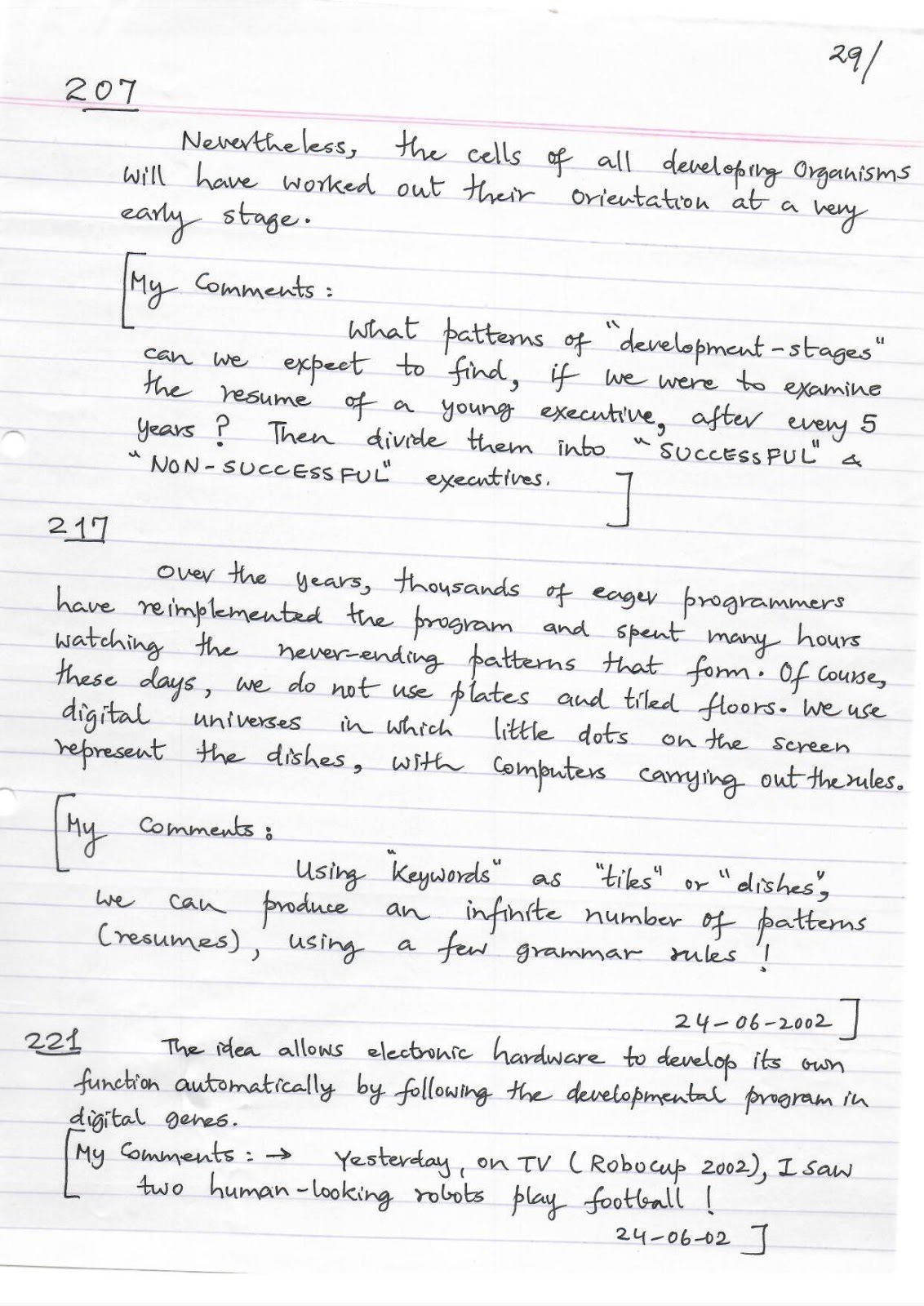
Nevertheless, the cells of all
developing Organisms will have worked out their orientation at a very early
stage.
[ My Comments:
What patterns of
"development-stages" can we expect to find, if we were to examine the
resume of a young executive, after every 5 years? Then divide them into
"SUCCESSFUL" $\&$ "NON-SUCCESSFUL" executives. ]
Over the years, thousands of
eager programmers have reimplemented the program and spent many hours watching
the never-ending patterns that form. Of course, these days, we do not use
plates and tiled floors. We use digital universes in which little dots on the
screen represent the dishes, with computers carrying out the rules.
[ My Comments:
Using "Keywords" as
"tiles" or "dishes", we can produce an infinite number of
patterns (resumes), using a few grammar rules!
24-06-2002 ]
The idea allows electronic
hardware to develop its own function automatically by following the
developmental program in digital genes.
[ My Comments: $\rightarrow$
Yesterday, on TV (Robocup 2002), I saw two human-looking robots play football.
24-06-02 ]
We have just discovered that when
we use computers to evolve the right kind of "development programs"
all generates a set of instructions and not a solution directly. Because
evolution directly, you don't need more genes in order to get more complicated
solutions. $\mathbf{\dots}$ In exactly the same way, as the size of the
solution increases does not need to increase as the size of the digital genes
does not need to increase. $\mathbf{\dots}$
Not only that, but processes of
development are rather good at producing solutions that display certain kinds
of order in them.
Because the same Genetic
instructions will often be reused quite a few times, certain patterns such
as repetition, segmentation, symmetry and subroutines will tend to form
naturally.
[ My Comments:
grammar rules? forming
"patterns" in resumes. eg: paras/sentences/phrases/sequence etc. ]
The patterns of plants aren't
random $\mathbf{-}$ they are the result of golden mathematical laws selected
for their near perfection. $\mathbf{\dots}$ Somehow, when lots of simple things
get together according to a few rules you get more out than you put in.
[ My Comments:
Once we are able to discover the
"patterns" (of Keywords / Key phrases / Key Sentences / Key paras)
followed in resumes, we may discover their "Golden Mathematical
Laws".
Millions of unique resumes, all
built $\&$ put together from a permutation/combination of a few hundred
Keywords, following simple grammatical rules.
03-07-2002 ]
Well, it gives us some clues
about how certain aspects of biology may work. Like the Periodic Table in
chemistry which predicted the existence of new elements, this simple law may be
able to fill in some gaps in our knowledge of how biological systems work.
[ My Comments:
Someday, we will create a
"Periodic Cube", whose three sides are,
Industry/Function/Designation-level ($\text{210} \times \text{120} \times
\text{10}$) AND populate each "CELL" of this cube with
"probability of occurence of Keywords". What will it predict?
03-07-2002